
We have addressed the importance of selecting a veterinarian for your pet capybara. What happens when the time comes to escort your feisty beast to the clinic? It’s not quite like taking your puppy in for his first vaccines.
Your veterinarian is aware of your pet, because you have carefully selected and notified the doctor that you have a new exotic pet in the household. Even the most intrepid of veterinarians will not be pleased to discover that they will be meeting their first capybara in *glances at appointment log* five minutes. Nor will your neighbor be amused by discovering that your capybara has a veterinarian appointment “in half an hour” and that you need help getting him into the backseat of your Kia “now.” And they need to come with you for the visit.
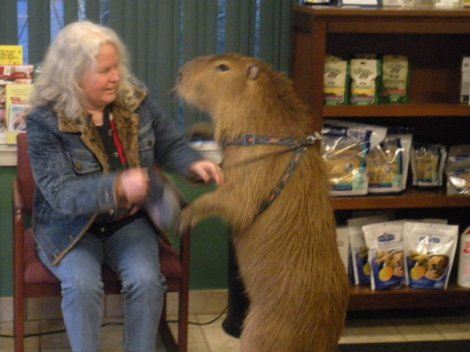
The transportation aspect of going to the vet was usually the most difficult part of the event. And coaxing a full grown capybara into a crate was not a viable option for us. We would need an XXL dog crate that would fit into my Subaru Forester. A 135 pound lurching animal (plus the weight of the crate) is impractical to lift into the car, possibly less practical to lift out and carry into the vet clinic. We opted to walk him on a leash.
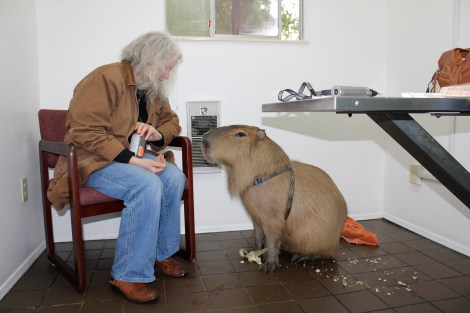
If you have been driving around with your capybara since he was little, and he is perfectly trained to walk on a leash beside you, you are way ahead of me. I used to take him places but as Dobby grew into the opinionated beast that we all knew and loved, it became impractical. Plus, older Dobby became dreadfully carsick and that was the end of casual car trips.
Here is your Trip To The Vet Checklist:
- Your capybara is already trained to wear a harness and walk on a leash.
- Your car is set up so that you can get him up into the car and you have practiced it.
- You can drive safely without him trying to crawl forward and into the driver’s lap.
- The capybara transport interior is capybara-proofed so that you can use it for humans after the visit.
- You have a wrangler to help get him out of the car, across the parking lot, and into the vet clinic.
- You have a suitable bucket of treats packed and available to keep him occupied while you wait for the vet.
1. When I trained Dobby to put on his harness, I selected the location where the gate leads to the front yard and driveway. He loved going to the front yard and so was willing to put on his harness because he wasn’t allowed out there without it. He never questioned that he would be putting on his harness at this location.
Your capybara can and will slither out of that harness once you attach the leash and start to walk. He will simply turn to face you and back out. The harness will slip over his head and drop to the ground. To prevent this, you need to keep the capybara moving forward ahead of you. My solution was to recruit someone to hold Dobby’s leash behind him while I walked ahead of Dobby so he would follow me. Dobby always wanted to mark the leash with his morrillo, so I let him do that before we headed for the driveway. Keep that leash taut and don’t let him turn around!
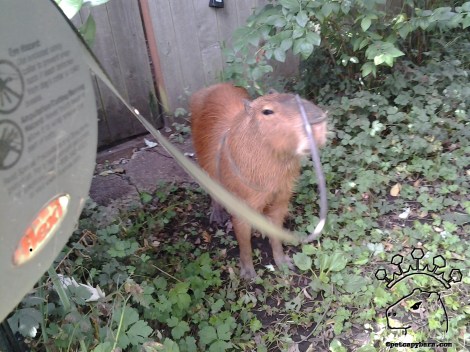
Dobby is marking the leash with his morrillo.
2. It was too risky to train him in the driveway, so I set up the ramp in the backyard. We practiced going up and down the ramp until he got used to it. Raisins were the treat we used for that “trick” and that was what I used when the time came to go up the ramp to the car. The first few times I had my wrangler stand with him at the ramp while I walked around and coaxed him in from the open door on the other side. Getting him out was tricky, too. Since he would follow me and move away from the wrangler, we traded positions to get him out, with the wrangler menacingly at the far door, and me with the leash at the ramp.
-
- Not coming out
-
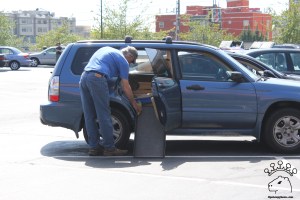
- Wrangler at the ramp
-
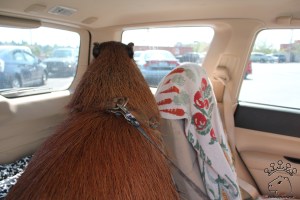
- Nope, not happening
-
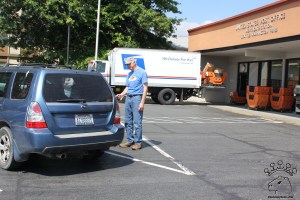
- Wrangler moves to other side of car
-
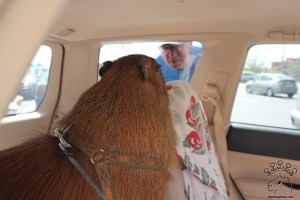
- Dobby decides to move away from the wrangler
-
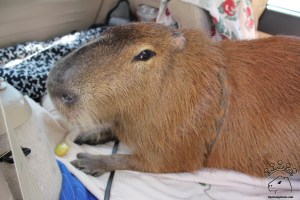
- Dobby faces me and reluctantly prepares to descend the ramp
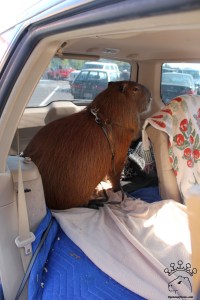
3. Because Dobby was so nervous in the car, I had to sit in back with him. Fortunately, my Subaru had split back seats so I could buckle up and Dobby had a spacious area next to me. When the car was moving, he was seasick and laying down. Whenever the car stopped, he was up walking around, looking for an escape, such as the front seat. He also had a cute habit of walking forward to nibble on the driver’s ear, so we had to secure a fence behind the front seats.
-
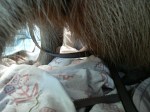
- Riding shotgun, trying to keep the leash from getting tangled underneath him (2011)
-
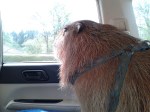
- He would sit or stand to look out the window whenever the car stopped (2016)
-
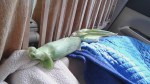
- Emergency corn at the fence blocking the gap between the front seats where he previously bit a chunk out of the center console
-
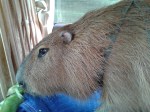
- The corn kept him from nibbling my ears as I rode in the back with him
-
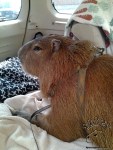
- That’s his favorite travel-sized pirate bed and a few towels (2013)
-
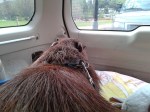
- We spread out a thick moving pad with blankets over it.
-
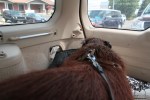
- About 4 years old and not happy to be in the car again
-
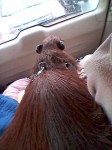
- The car seat and back is covered by a blanket, and the front seats, too (2016)
4. That’s a lot of laundry, but it’s easier than cleaning corn juice off the seats. He was very nervous in the car and sweated profusely, shaking and getting flecks of sweat all over the interior. Sometimes he would poop in the car, usually on the way home. A patchwork carpet of smaller towels could be rolled up to help keep him from soiling the entire car as he got up and walked around at each stop.
-
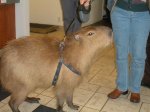
- Dobby could back right out of that harness if a dog suddenly enters the lobby. I should be standing behind him.
-
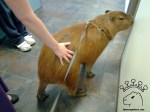
- This is the proper position: leash held taut behind the capybara
-
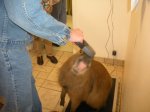
- Rubbing the leash on his morrillo, again
-
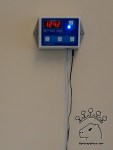
- Dobby would eventually reach 136 pounds.
-
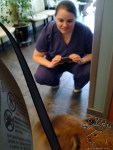
- See that row of brand new chairs behind the vet tech? Dobby took a bite out of the seat cushion of one on the way in.
-
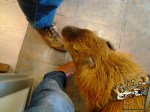
- Standing with the wrangler close by because . . .
-
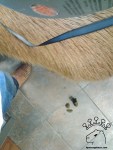
- . . . someone was coming to clean up the poop that fell out of Dobby after he bit the chair
-
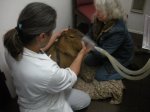
- I’m on the floor assisting Dr. Vincenzi with the anesthesia
5. I’m serious about the wrangler. I once flew from Seattle to Austin to accompany Melanie Typaldos’s Garibaldi to a dental appointment. These photos are at Texas A&M, a veterinary school. (It is my understanding that they no longer have an exotic pet department, only agricultural subjects.) I was the driver/wrangler while Melanie tended to Gari.
-
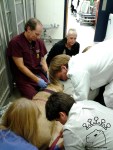
- Melanie at the back, a variety of vets and students hovering
-
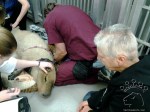
- Due to Gari’s poor nutrition before he came to live with Melanie, his jawbone was not dense enough to support his incisors
-
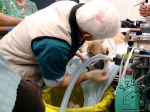
- The dental surgeon is removing his incisor, which practically fell out into his hand
-
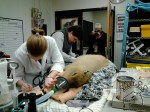
- Trimming his nails while he was still under anesthesia
6. A bored capybara is a naughty capybara. I always packed a bucket of treats to keep Dobby busy in the waiting room. (Remember the chair bite?) The vet clinic isn’t likely to have corn on the cob available.
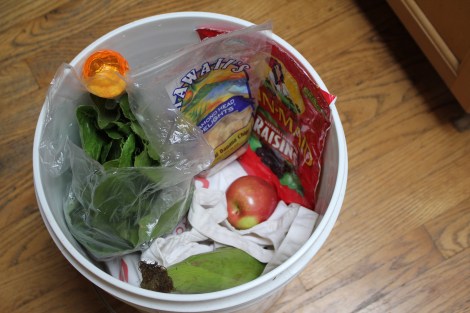
Treats packed for a trip to the vet. You never know.
Pet capybaras are tame wild animals, nothing domestic about them. Your experience with taking a dog to the vet isn’t going to be much help. Capybaras slip away from their enclosures, even at zoos, and taking them from their familiar home to a parking lot and then a vet clinic (with random dogs and cats in the waiting area) is asking for trouble unless you have thought it out beforehand. Hope this helps!
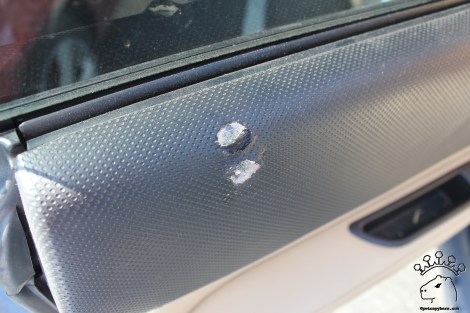
Just a little bite on the inside of the car door
~~~~~~~~~~
This post was brought to you by Stacy’s Funny Farm, a non-profit pet sanctuary and former home of Dobby the capybara. We hope you will be inspired to make a donation. We especially appreciate monthly giving- the PayPal portal offers that option. If you want to help but are short on cash, head over to Dobby’s YouTube channel. We’re monetized and those ads pay out nicely, so please watch, share, and subscribe. If you didn’t watch the videos (some are disguised as links), please go back and click on them! No need to watch all the way to the end. Thanks!
Stacy’s Funny Farm is a §501(c)(3) non-profit organization.
stacysfunnyfarm@gmail.com EIN 47-1397412

