
Capybaras are grazing animals. In their native habitat, they graze day and night on coarse grass and shrubs near the water’s edge.

For those of you eager to bring a capybara into your home, consider that this animal will want to graze day and night on whatever you have available. They need food available 24/7 so make certain they always have hay and vegetables, and top off those bowls before you go to bed. If your capybara eats up all of that (or maybe becomes bored) he is going to test taste everything within reach, just in case.
Electrical cords, shoes, blankets and bed ruffles, anything down at biting level is vulnerable. I say that as if capybaras stay this size- that bottom drawer is 9″ high (22cm.) He grew to be three times that tall. The following photos are from his early days.
-

- Dobby disappears
-
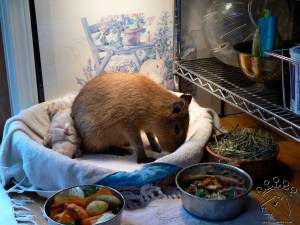
- Baby Dobby is saying his prayers before dinner. It is never too early to teach a capybara good manners.
-

- It’s better with a capy-cave.
-

- Dobby chews my sweater
-

- Outdoors where the only damage he can do is to hoses and pools
-
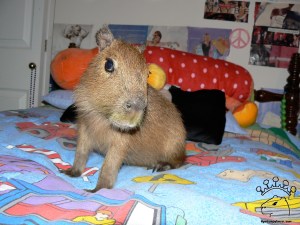
- Green whiskers from grazing on grass
-

- Wipe that green juice on white curtains
-
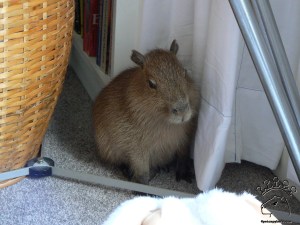
- When he walked away, there was a freshly chewed hole on that curtain
-
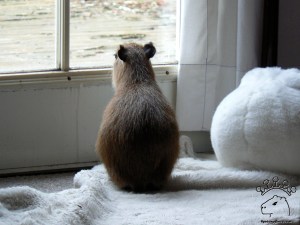
- The picture of innocence
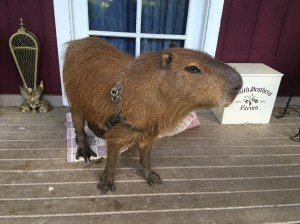
A full grown capybara would be more likely to bite a big hole in the middle of that carpet. He would also have cleared off that lower shelf, swallowed the button off my sweater, chewed up those stuffed animals and quilt, and yanked the curtains down to the floor.


~~~~~~~~~~
Stacy’s Funny Farm is a §501(c)(3) non-profit organization. We appreciate donations of any size. Monthly giving is especially helpful. If donations are beyond your means at the moment, please stick around Dobby’s YouTube channel (@hippopotatomus) and watch a few videos. We make a lot of money off of those ads!
 Dobby the Capybara