
I don’t claim to be an expert on capybaras because my sample size (of one) is too small for any viable scientific analysis. What I can claim is relative success in raising and caring for that one capybara, Dobby.
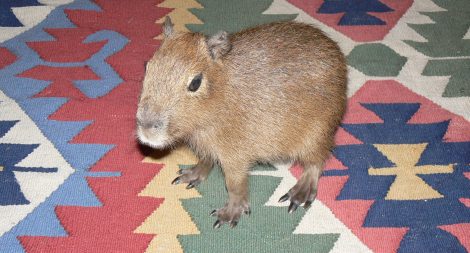
Dobby at five weeks old
In those days, the only information available was in a book called Capyboppy, by Bill Peet. Bringing Dobby home was do-it-yourself. What follows is my own experience with about fifteen years of capybara consulting thrown into the mix. Maybe it will help you think through this first important step in capybara care.
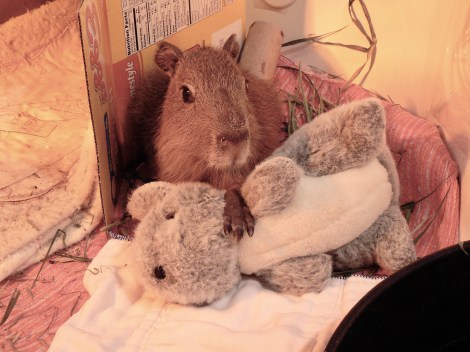
Two weeks after his arrival with his new friend
Choosing a breeder is an iffy endeavor because there are hordes of scam artists eager to take your deposit. If your research doesn’t uncover reliable breeders, you have more work to do. Reputable breeders won’t sell to just anyone, so your request should include your own qualifications. Having a dog or cat isn’t going to impress a breeder. Experience with prey animals (rodents particularly) and exotics is what they are looking for. That gets you on the waiting list. Be patient! Quality stock is worth waiting for, and I’ve seen the pathetic results of unfortunate inbreeding, so don’t be shy about asking your breeder about the heritage of their stock. I was on several waiting lists for over a year before Dobby became available.
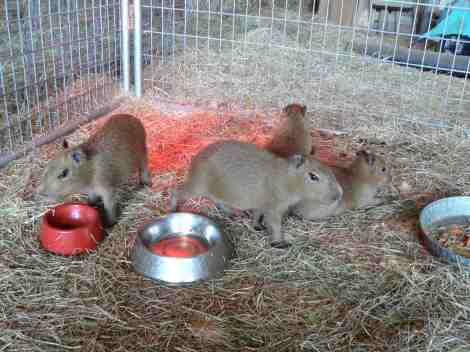
Dobby’s siblings
Capybaras are wild animals and the domestication process (which takes thousands of years) has not yet begun. That means that your baby capybara is a wild animal. For that reason, I recommend getting a capy as young as two to four weeks old. As wild animals mature, they become more wild and unpredictable. Imagine a three week old tiger, for instance. Very cute, right? You can hold it and play with it safely. How about a two month old tiger? Probably still cute and friendly but a handful and bites and scratches are expected. A two year old tiger, no way José. Capybaras are “terminally chill” but back a mature one into a corner and you are asking for trouble. Get a baby one, spend all of your time with it, train and tame it, and hope it bonds with you. I was lucky. Some capybaras are just skittish and never truly bond to their caregiver.
-

- Three weeks
-
- Six weeks
-
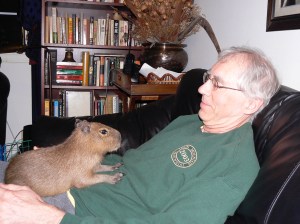
- Ten weeks
-
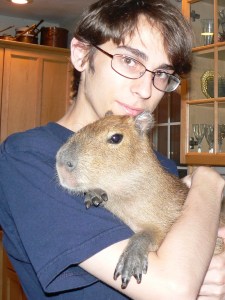
- Fourteen weeks
What about rescue capybaras? Somehow, people think they might be able to pick up a rescue capybara on the cheap, all raised up, friendly and tame. Capybaras are not domestic animals, and “older” does not guarantee “chill.” I have seen a few older capybaras offered up for sale, but taking in a rescue capybara isn’t like taking in a puppy from the pound. A gentle and affectionate capybara is unlikely to be available for sale. If it hasn’t had adequate early nutrition, you could be looking at serious vet bills as it ages. I wouldn’t recommend taking in a rescue capybara without meeting it in person. Be prepared to walk away if you aren’t satisfied with the encounter. Generally, rescue capybaras are a wild card best reserved for experienced capybara wranglers.
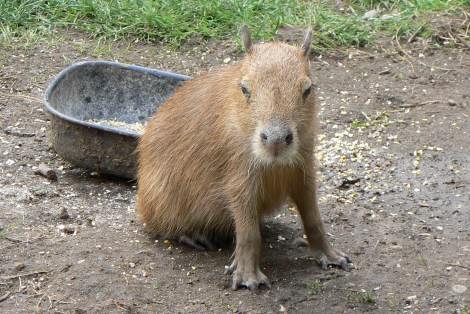
Two months old and already he’s got an attitude
How many capybaras should you adopt? Quite honestly, I was very busy with one, and he required constant attention. I remain convinced that if you are looking for a pet to bond with, and you have the time to devote to a very demanding animal, one capybara is plenty. These days, the standard is two- two cats, two guinea pigs, two whatever. That is fair if you are away all day. Animals thrive with companionship. I have found with most pets, one will bond with you, but if you get Number Two, they bond to each other and are less dependent upon you for company. To get the most out of your capybara experience, I recommend that you get one, quit your job, and dive in. If you are only interested in them for the novelty of it, go ahead and adopt two and hire a trainer to stop by daily to care for them.
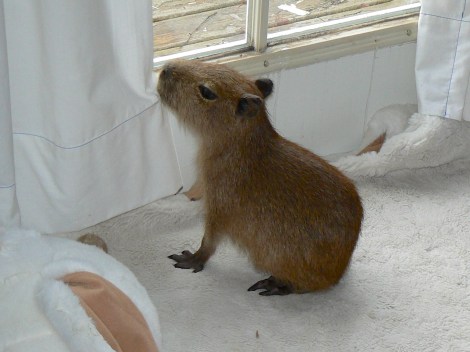
Eating the curtain at five weeks
Gender is an unpredictable variation on the theme and I haven’t seen any useful personality differences if you are getting one animal. Two male capybaras raised together are likely to fight when mature. Duplicating separate penned areas takes space, funds, and time. A related pair will likely breed, and inbreeding has become an issue with the limited breeding stock originally imported from South America. Please don’t exacerbate the situation by adopting pairs that are siblings. Two females are your best bet, but breeders are reluctant to let females go and charge dearly for them. Plus, baby capybaras are notoriously difficult to sex, so there’s that.

So glad I didn’t get the bitey one!
If you were getting a puppy, ideally you would meet the breeder, meet the parents, and personally select your pet. Capybaras are not beginner pets and you are likely to have many questions during the first month. Your breeder is going to become your best friend, so choose carefully! You are unlikely to find a capybara breeder nearby, but I still recommend that you meet the breeder and select your capybara in person. When I met Dobby, he was a sweetheart. I checked out the others in his litter, but two were absolutely impossible to catch. The fourth one allowed me to corner her. I picked her up, and then she peed all over me. I’m not impressed by bad behavior so I held on and then she reached over and tried to bite a chunk out of my arm. I took home Dobby. Still, there are people who prefer to have their new pet shipped, sight unseen (bite unseen.) Also, an in-person visit is your last chance to reconsider, so look around the facility and make certain you are up to the challenge of raising a wild animal.
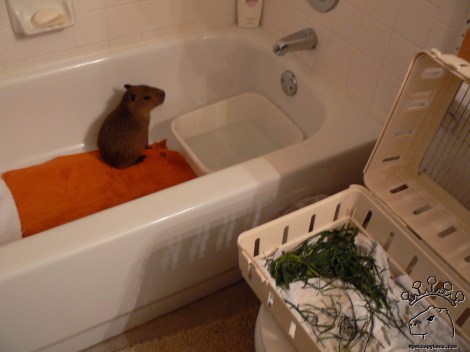
First overnight was at my sister’s house. That is his airline-approved carrier. We flew home the following day.
I selected Dobby and decided to fly home with him. There are no airlines that allow rodents in the cabin of the plane. They are fussy about the carrier that you use, and they inspect it and make sure you follow regulations (veterinary inspection papers, provide a day’s worth of food, etc.) All of that to stow him with barking dogs and yowling cats in the cargo hold. It was March and freezing in Seattle when the plane landed. Twenty minutes later when they finally brought him into baggage claim he was a three week old capybara popsicle. Ten days later I was treating him for pneumonia.
-
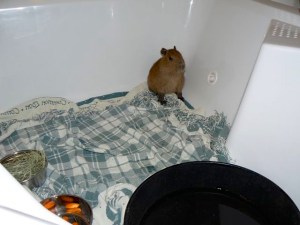
- Lost in my big bathtub
-
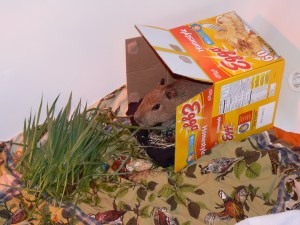
- He felt safer in his waffle box hideout
-
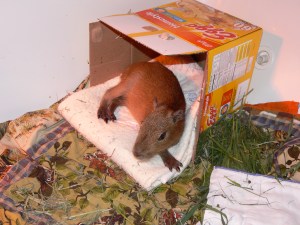
- A couple days later and not as fearful
In hindsight, I would have driven across the country with him in a rental car. Baby capybaras, at a glance, look like a rabbit. Anyone could sneak one into a motel room for the night. Bring him back a salad (hold the dressing) from Denny’s, park him in the bathtub in a clean towel, keep on driving. Bribe a friend to come along for a once-in-a-lifetime adventure, and Bob’s your uncle. Having said that, if you trust your breeder, by all means have your baby shipped. It will likely arrive at a cargo terminal at your airport, so make sure you know where that is and keep in contact with your breeder throughout the process. Baby capybaras are more vulnerable than puppies and a baby that has spent several hours in the purgatory of airline possession will not be happy. I used to have ducks shipped all the time, so I was familiar with the process and the location of the cargo shipping companies, but even ducks arrive a bit shell-shocked. Get there on time and drive straight home.

Two months old
I recommend that you take possession of your baby capybara at about three weeks old. This will be a tiny capybara- bigger than a guinea pig but smaller than a rabbit. It will triple in size in three months, double that in a couple more. (That means that all the home accommodations you set up for the baby will be useless in a few months.) I set Dobby up in my huge Jacuzzi tub and was shocked to discover that he could jump right out within a week or so. (And he had pneumonia!) That tiny animal you bring home is going to grow into a mini-monster before your eyes. Be prepared to monster-proof your home continually.
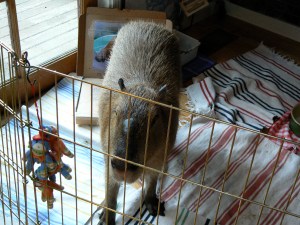
Fourteen months, a bit over a year. He learned to grab the x-pen with his teeth and carry it out of his way.
Looking at my old photos, I am amazed how long he respected the X-pen I used to confine him to the kitchen. Grown capybaras will easily leap over a four foot fence if they have a hankering for what’s on the other side! Young Dobby was respectful and accepted the limitations I enforced with flimsy barricades, but teenaged Dobby pushed the envelope. If you have a carpenter friend, invite him over to meet your baby capybara when he is still manageable. You will need skilled and understanding workers later, and it’s nice if they aren’t terrified by the gigantic rodent in your kitchen.
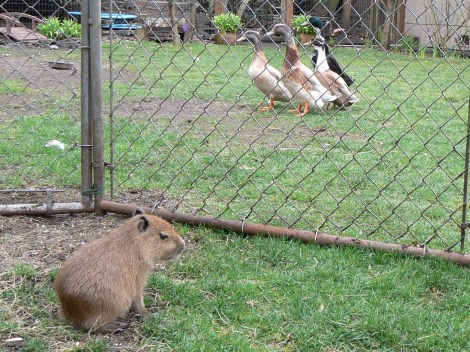
Smaller than a duck at six weeks
Capybaras belong outdoors. In their native habitat, they are outdoors 24 hours a day. Your capybara will not thrive indoors, sleeping on the couch, watching TV with you. Without sunlight they won’t get enough Vitamin D and they cannot graze on your shag carpet. Still, you can’t set a baby outside to graze alone. In the wild, the herd would protect them. I went right out and got a goose (gander) to protect Dobby. Norman the goose grew even faster than Dobby and was predisposed to watching over his flock, so it worked perfectly. (Norman is still my flock manager at 16 years old!) If you have a dog with the right personality, he may protect your baby capybara. If you have a terrier, your capybara is just another rodent. Your baby needs to be outside as much as possible, so consider how you will accommodate twelve hours of safe grazing. I have Bald Eagles nesting nearby which is new since Dobby was here. Big Boy Dobby would be fine, but the tiny guy who used to graze in the back yard would not be safe now.
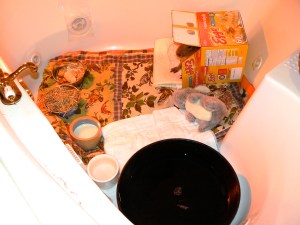
Note the potty bowl, foreground. A week later and he was jumping straight out of here.
Potty training a capybara is easy compared to training small humans. They readily pee and poop in a tub of water, so don’t waste a lot of time on it. As the cleaner-upper, you need to think that through carefully. Try this: select the container you intend to use, fill it with water, dump it out. Is everything conveniently located? Did you spill? You will be doing this several times a day. Your baby capybara will probably be using this indoor setup for a couple months. The most convenient dump zone is a toilet. A container (I used a rubber hog feed bowl) full of poopy fluid is an unsteady vessel and ought to be located as close to a toilet as possible. Assuming you intend to clean it and refill it with water, you might want to consider the logistics of that, too.
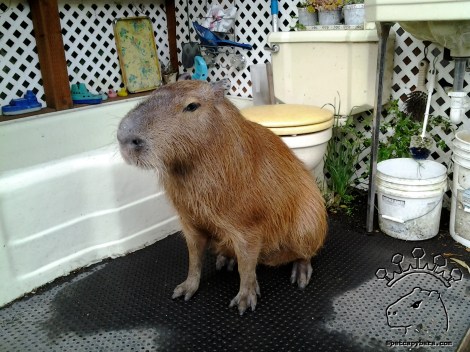
I ended up building him an outdoor bathroom.
It’s only for a couple months, or is it? If you plan to welcome your capybara into your home indefinitely, you should carefully consider your capybara potty room location. Do you really want to sacrifice your guest bath or are you willing to share the master bath? I placed Dobby’s poop bowl in the shower stall of the master bathroom. Splashing was contained, it was only a couple steps from the toilet, and could be efficiently cleaned in the shower stall. I just quit showering for a few months. Ha, kidding!

Dobby moved outdoors to sleep at about six months. The bartender and I slept on that bed for the first two nights but Dobby loved being outdoors, with or without us.
It was good enough, and as it happened, once Dobby moved outdoors (at six months he began to “mark” all over the house) he never used his indoor latrine again. I do know of other fastidious capybaras who continued to use their indoor potty for years, so beware. Your baby, though will establish his potty habits quickly and may not appreciate your change of heart if your Thanksgiving guests are not amused by the potty bowl in “their” bathroom. Your capybara isn’t likely to appreciate having his toilet location become a moving target, either.
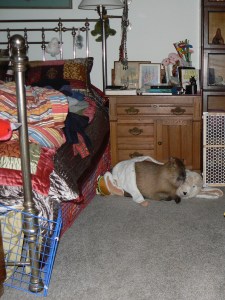
For a short while he slept next me, but on the floor. Then he began to urinate there, and waking up to a naughty boy and a housekeeping chore grew tiresome. Note the bed-ruffle barricade.
You have gone to a lot of trouble bringing your baby capybara home, but it’s bedtime and you are tired. Your little guy has been sleeping most of the day and now he wants to wander and explore. In the wild, capybaras graze day and night, cat-napping during the day. Maybe your plan was to have him sleep in your bed, but you have brought home a wild animal, a free spirit. He’s hungry. Predators kill, gorge, and sleep it off. Grazers nibble constantly. Many of the low weight capybaras I hear about did not have overnight access to food. If you are familiar with guinea pigs, you are familiar with this feeding regimen. They eat day and night, whenever food is available. If food is not available, they let you know. Guinea pigs are domestic and they know where the food comes from. Capybaras are wild animals, wary of predators (like humans), and they hide their distress. Make sure they have access to food all night long and watch it disappear.
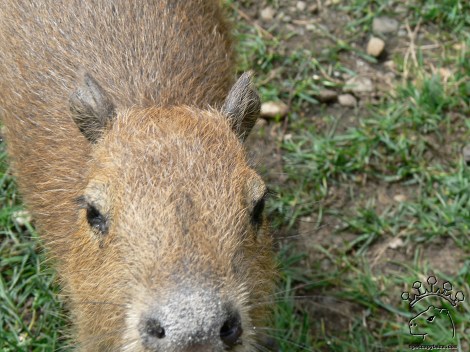
“Don’t even think about it!”
I could go on and on about our first few months together, but I think you get the idea. Read everything you can find and consider the source. Most people writing about capybara care have never experienced it first-hand. The misinformation is flourishing and now there are dozens of AI websites hosted by random freelance writers who are recirculating speculative garbage. I don’t claim to be an expert on any capybaras beyond Dobby, but nine and a half years together was a life-changing experience.
~~~~~~~~~~
This blogpost was brought to you by Stacy’s Funny Farm. We hope you will consider a donation. We especially appreciate monthly giving- the PayPal portal offers that option. If you want to help but are short on cash, head over to Dobby’s YouTube channel. We’re monetized and those ads pay out nicely, so please watch, share, and subscribe!
Stacy’s Funny Farm is a §501(c)(3) non-profit organization.
Give through your Donor-Advised Fund. Use our Tax ID (EIN): 47-1397412 to recommend a grant from your DAF.
 Dobby the Capybara