
We continue to hear about underweight, underfed capybaras. We continue to recommend Vitamin C supplements for all capybaras, regardless of age. Basically, capybaras are gigantic guinea pigs, so if in doubt, read up on guinea pig nutrition. If your capybara is underweight, what can you do? It’s time to talk seriously about diet.
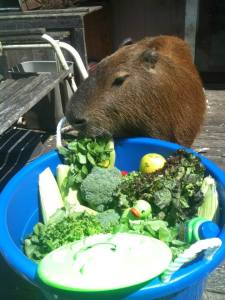
A gift for Dobby! A huge bucket of vegetables!
What do wild capybaras eat? We all know that they eat grass, so how hard is it to feed them? It turns out that it isn’t so much the grass, but the quantity. In the wild, capybaras graze night and day. Where capybaras live, near the equator, the seasons are subtle. The daylight hours don’t change much from summer to winter. The weather is mild- milder than Florida- and grass grows all year long. What pet capybaras need is a similar habitat where they can graze year round, all day and all night. There really isn’t a climate in North America comparable to Brazil. Even if you have acres of fenced-in year-round grass, most pet owners are wary of setting baby capybaras outdoors day and night. It takes about a year for them to grow large enough to fend off predators, including and especially neighborhood dogs. It’s the babies that need a buffet that’s open all-hours. Poor early nutrition can lead to scurvy and rickets which can cause deformed bones, and can’t be corrected after the damage is done.
-
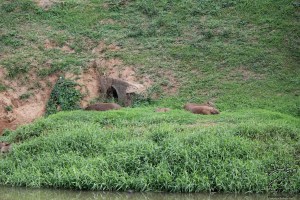
- Sleep all day
-

- Eat all night
-

- Hide in the bushes!
Photosynthesis converts solar energy to chemical energy, in the form of carbohydrates in the foliage. At night, this daylight energy is stored in the roots. What that means for grazing animals is that there is a daily fluctuation in the amount of carbohydrates available. I’ve witnessed this in my sheep. As the sun sets, they begin to graze ravenously, unlike their lazy daytime grazing. In an over-grazed pasture there isn’t enough green foliage to both satisfy the grazers and leave enough to store nutrients in the roots. In the wild, capybaras migrate a bit in search of longer grass, but they also eat other types of foliage so they don’t need to travel far.
Let’s take a look at those other plants. They provide clues about what we can feed capybaras when we can’t provide 24/7 grazing. In the wild, their foods come from four main plant families: Poaceae, Cyperaceae, Leguminosae, and Pontederiaceae. Put in familiar terms, these families are grasses, sedges, peas, and watercress. Grasses include about half of their food, with the others combining to form the remaining half. In addition, if they are available, they will munch on water hyacinths, stargrass, smartweed, sweet potato, bulrush, and mimosa (sensitive plants.)
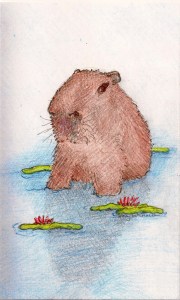
Dobby with water hyacinths
Still, the Poaceae family is the important one. In Brazil it includes grasses like lemongrass, Bermuda grass, switch grass, and elephant grass. Bamboo is a crazy big grass, and so is corn! None of these are little wimp grasses like fescues or golf course greens. They are all big coarse grasses like St.Augustine grass you find in Florida. Good grazing, but not soft barefoot grass. Dobby ate the Reed Canary Grass (Phalaris arundinacea) in my yard more readily than the tender fescues. However, it is seasonal here, going completely dormant half the year. Besides that, it’s considered an invasive species here, so it’s not a plant to encourage! In winter, I used to bring in daily buckets of bamboo foliage for him. In summer, I foraged at the farmer’s markets for corn husks. He loved the corn, too, but never turned away a bucket of fresh empty corn husks.

Dobby has demolished another bucket of bamboo.
The Cyperaceae family in Brazil includes aquatic plants with tubers like water chestnut. They also have papyrus and giant sedge. These are big rangy grass-like plants that love soggy soil. I used to have sedges, but they mysteriously disappeared after Dobby discovered them. I suspect it’s too cold here for papyrus, but I recall seeing them in California. Great plant for swamps in mild climates.
Leguminosae is the pea family. As a kid I loved playing with Mimosa pudica, the sensitive plant. The leaves fold up when touched. That’s the kind of pea family plant they are talking about in Brazil, not acacias or Chinese snow peas. As forage for capybaras, our best bet is alfalfa. It isn’t like Orchard Grass and Timothy, which are Poaceae. Alfalfa is a legume. The protein content is high, so it is a good bet if your capybara needs to put on weight quickly. It can make them fat, though, as rabbit and guinea pig owners can tell you. Most pet shop rabbit and cavy food is alfalfa based, which is why veterinarians recommend timothy-based pellets to maintain a healthy weight.
The fourth most common family is Pontederiaceae, which in Brazil includes seriously aquatic species like watercress or miners lettuce. Capybaras are semi-aquatic, never far from a water source. Dobby would absently graze on any plant that got near his mouth, so it’s no surprise that a fair amount of aquatic species end up on the list of plants they eat in the wild. I used to buy him water hyacinths, seasonally, and sometimes they managed to bloom before he ate them. This is another invasive species, though, so beware!
-

- Aquatic habitat in Brazil
-
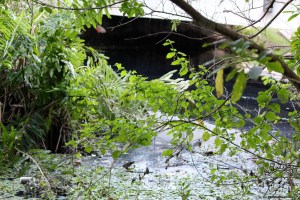
- Their hangout under a bridge
-
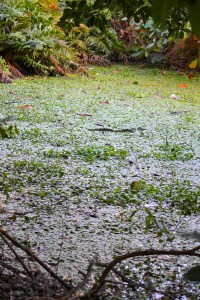
- Plenty of aquatic vegetation
In urban areas, they are opportunistic, eating a variety of species, native and/or cultivated, they are singularly capricious about their choices. They will strip the bark off trees and “taste” just about anything. As water levels fluctuate, they will wander upslope, and in urban areas the dietary selection is intriguing. The question remains, what do they eat when their native habitat is not available?
-
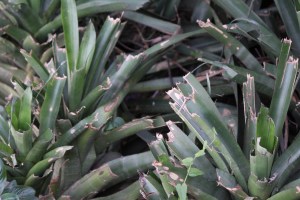
- Chewed up plants . . .
-
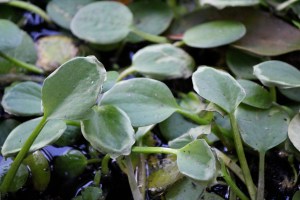
- . . . near aquatic habitat
In Brazil, escorted by naturalists to a favorite capybara hangout, I observed a variety of aquatic species. Mostly floating vegetation, the plants resembled watercress, a tender small-leaved floating plant. Along the banks of the stream were many yucca-like shrubs with familiar bite marks.

In Panama, the capybaras at our hotel hid in willow thickets during the day. They emerged at night to graze on the grass along the tributary to the canal. Sneaking down to the scattered lagoons, I observed them foraging on the willow as well as the nearby banana foliage. I was stunned to discover that bamboo is everywhere, but that is fortunate for South American capybaras who have not the means nor the fare to travel to China for it. The lesser capybaras roamed under cover of night between adjacent lagoons, stopping to graze on the grasses- and bamboo- between them.
In North America, we have neither the climate nor the vegetative buffet that their native habitat provides. How can we compensate for that? First, we must offer a larger quantity of food to make up for our shorter daylight hours. Second, we must offer more Vitamin C rich foods to make up for the constant availability of fresh grass. I am no botanist, but it remains clear that fresh grasses provide more Vitamin C than dried grasses (hay) do. Third, we must be creative with the foods we have available to compensate for the quantity and quality of forage which we do not have.
-

- Capybaras at a breeding facility
-

- Little was a very big capybara
-
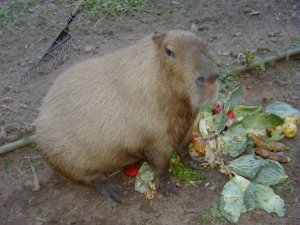
- She had a good appetite
-

- Photo credits: Mary Lee Stropes
Grass, coarse fresh grass must be available, night and day. Some alternatives to fresh grass include bamboo foliage, willow foliage with twigs, and fresh corn husks. Supplement that with free access to hay (timothy, orchard grass, and/or alfalfa) but understand that hay lacks essential nutrients. It does form the bulk of their diet, and I do mean bulk. Without adequate fiber, nothing else moves through them properly.
Like guinea pigs, capybaras need “salad” for additional fiber and nutrients. Capybaras get picky as they mature, so it’s important to feed them a variety of fruits and vegetables before they talk to their friends at school and decide that some veggies are uncool. Romaine lettuce is a good start, never iceberg lettuce. Dobby ate a head of romaine every day.
Kale is a smorgasbord of vitamins, minerals, and fiber. Other vegetables to try are cabbage, cauliflower, and broccoli. Ignore everything you have read about raw potatoes and offer every type of potatoes and yams that you can find. Dobby ate about eight varieties. They provide great roughage and a surprising amount of Vitamin C. Dobby never liked squash, but most capybaras will eat any kind of squash, from zucchini to acorn squash. Squash is cheap and available year-round.
Fruit has a lot of unnecessary sugar, and Dobby unexpectedly preferred potatoes to apples. Still, when the apple tree dropped fruit, he was right there. Foraging is an important behavior for intelligent animals. Carrots have a lot of sugar, and melons, too, but they are seasonally cheap and plentiful. If in doubt, check the guinea pig recommendations, and always go for foods rich in Vitamin C.
I am appalled by zoos who feed “monkey chow,” especially when herbivore and graminivore biscuits are available. At least go for the alfalfa cubes, if you must. Guinea pig pellets are usually fortified with Vitamin C, unlike rabbit pellets, so don’t be fooled. They look exactly the same, but they’re not. If you can’t get guinea pig pellets in quantity, equine pellets (especially the ones with beet root pulp) are an excellent substitute, if you substitute with Vitamin C at the rate of 1,000mg daily.
I know I didn’t mention the capybara favorite, corn on the cob. They love it, but it’s full of sugar. It’s a great training tool, offered with husks on. They will readily eat it from visitors and they love to show off the way they can take a great big bite- husk, silk, cob and all. It scares and delights your friends, so keep some on hand for special occasions.
~~~~~~~~~~
References include the following:
Almeida (Tonetti), Ariádina & Biondi, Daniela. (2015). Dieta De Capivara (Hydrochoerus hydrochaeris, Linnaeus, 1766) em Ambiente Urbano, Parque Municipal Tingui, Curitaba-PR, Brasil.
Forero-Montaña, Jimena, Betancur, Julio, & Cavelier, Jaime. (2003). Dieta del capibara Hydrochaeris hydrochaeris (Rodentia: Hydrochaeridae) en Caño Limón, Arauca, Colombia. Revista de Biología Tropical, 51(2), 571-578.
Kinupp, V. F.; Plantas Alimentícias Não Convencionais (PANC) no Brasil: guia de identificação, aspectos nutricionais e receitas ilustradas / Valdely Ferreira Kinupp, Harri Lorenzi; São Paulo: Instituto Plantarum de Estudos da Flora, 2014.
~~~~~~~~~~
This post was brought to you by Stacy’s Funny Farm, a non-profit pet sanctuary. We hope you will be inspired to make a donation. We especially appreciate monthly giving- the PayPal portal offers that option. If you want to help but are short on cash, head over to Dobby’s YouTube channel. That’s where these videos came from. We’re monetized and those ads pay out nicely, so please watch, share, and subscribe.
Stacy’s Funny Farm is a §501(c)(3) non-profit organization.
 Dobby the Capybara
thanks for your stories don’t have capys anymore but enjoy the memories
LikeLike
You are very welcome! Thank you for your years of support and guidance!
LikeLike