
The internet insists that capybaras are “terminally chill.” We’ve seen videos of capybaras riding alligators, capybaras being “eaten” by big birds, and capybaras raising puppies. Mothers with small children in strollers casually meander through herds of capybaras in Japanese zoos.

In the wild, capybaras are shy and docile. Like our small North American deer, they are not generally considered to be aggressive. Still, capybaras are wild animals, and won’t become domesticated in our lifetimes: that is a process that takes thousands of years. Wild animals retain the “fight or flight” instinct that is necessary for survival, so a capybara who is cornered or frightened will react in panic, the way a deer or even a rabbit will react. An adult capybara will weigh well over one hundred pounds in a very compact and efficient package, and they have razor sharp teeth. They may look like a potato but they can run over 33mph (53kmh), like Usain Bolt. Even so, a fearful capybara will attack unless it can escape. Sometimes, they attack even when unprovoked.
-

- Big hero takes video but eventually enters the lake to help.
-

- The young girl escaped without injury.
I have published hundreds of videos of my big (late) doofus, Dobby, wherein he appears as docile as a lamb. In fact, all capybaras are wild animals, even the ones kept as pets. Popular capybara videos show tame animals, trained to behave in a manner appropriate for their environment. In Japanese zoos that allow visitors to mingle with them, the capybara area is simply open to pedestrians. These capybaras have grown used to the zoo visitors and it is not uncommon to see families with small children work their way through the exhibit area. Yet, most of us who own capybaras have seen aggression in our animals.
Dobby once bit my daughter’s finger when I was away. Melanie’s famous capybara, Caplin, bit her daughter on the butt, leaving a scar the size of a quarter. Another pet capybara attacked and killed the family dog. Two males that had been raised as brothers had to be separated once they matured- one in the front yard, the other in the back, trading places strategically to allow them access to the pool. My friend Melanie was not able to successfully introduce her young male to an older female, though that would seem to be an ideal pairing. (video follows)
They can also become extremely territorial. Territory can be an area, a food dish, a favored human or co-pet, or in Dobby’s case, even “his” washing machine! Dobby’s territoriality extended to every being, human and animal, and his loud clicking, stomping, and lunging were unmistakeable warnings. Whether it was a visitor, the neighbor’s cat, or a new garbage can, Dobby could take offense. Members of his own herd seemed to get special dispensation, so hens, squirrels, and even I could enter his territory without notice. We were all careful not to startle him or “sneak up” on him because he tended to lurch around unpredictably and it really hurt if he stepped on your foot!
Of course, there are exceptions. Out of their home territory- for instance, at the veterinary clinic- they may become meek and well-behaved. Dobby loved his vet, tolerating exams and injections like a guinea big. Melanie’s rescue capybara, Garibaldi, shared his swimming pool with his veterinarian and her students. An older female named Cheesecake raised several litters of puppies at the rescue where she lived.

Garibaldi enjoys a swim with friends. photo credit: Melanie Typaldos
As for the Japanese capybara cafes and zoos that feature capybara encounters, the animals are selected for these venues. Just as some domestic dogs and cats have varied tolerance toward contact with unfamiliar humans, capybaras differ, too. Most of the videos I have seen feature young animals. It’s possible to safely play with an infant tiger, for instance, but as they mature, watch out! The same is true of most wild animals, even terminally chill capybaras. Single capybaras may remain docile longer, with care and training. A mature capybara in a herd might be more difficult to tame. Even at the Japanese zoos with herds people can meander through, those are females and young animals, with possibly one especially gentle male. Mature males will fight each other and are therefore removed to separate enclosures, or are traded to other zoos.

Dobby the capybara chases his beloved cat, Kitty Hawk.
We joke about “guinea bigs,” but capybaras are not uniformly docile. Even tame domestic pets surprise us with sudden strong feelings about individual guests. Most of the capybara videos I see are of very young animals, manageable size, well behaved, so very cute! Not too many of mature animals, two years and more. There’s a reason for that, and it’s important to understand that there’s a huge difference between wild and domestic animals once they mature. Domestic animals usually mellow as they age. Wild animals get wilder.
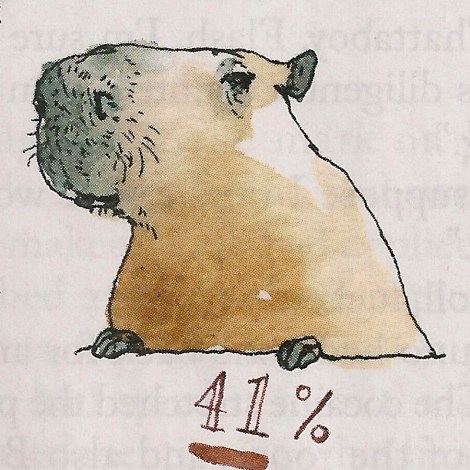
Finally, in this new Age of Misinformation, and especially as AI generated articles redistribute this dodgy mythology about terminally chill capybaras, let’s promote the good information. Hot off the presses, The New Yorker magazine has published a very fine article. I will provide a link here. It’s worth reading, though there are no photos. Instead I will post a photo of a drawing of my own Dobby that appeared in The New Yorker about nine years ago.

~~~~~~~~~~
Capybaras for Home and Garden is an in-progress capybara owner’s manual brought to you by the ROUS Foundation. Melanie Typaldos and I will post sections as they happen, in no particular order. Eventually, they will become a book, but for now, we welcome requests for information. Online information is hit-and-miss, so our challenge is to compile all these bits into one coherent volume. We don’t claim to know everything, but we hope you won’t repeat our mistakes!
~~~~~~~~~~
Dobby the Capybara blog posts are brought to you by Stacy’s Funny Farm, a non-profit pet sanctuary in the Pacific Northwest. We sincerely hope you will consider making a donation. We especially appreciate monthly giving- the PayPal portal offers that option. If you prefer a no-fee option, our bank uses Zelle. All you need is our email address- stacysfunnyfarm at gmail dot com. If you want to help but are short on cash, head over to Dobby’s YouTube channel. We’re monetized and those ads pay out nicely, so please watch, share, and subscribe.
~~~~~~~~~~


 Dobby the Capybara