
After the sudden, unexplained death of her first pet capybara, Caplin ROUS, Melanie Typaldos founded the ROUS Foundation for Capybara Veterinary Medicine. Ever since 2011, she has received random calls about capybara care. She installed me as Vice President a while back and now we both get phone calls, day and night.

Our most recent emergency involved a capybara in an ICU, receiving glucose. Its blood sugar crashed every time the veterinarian took the IV out. The first questions we ask are “How old is it?” and “How much does it weigh?” It was a five-month-old capybara, and it weighed five pounds.
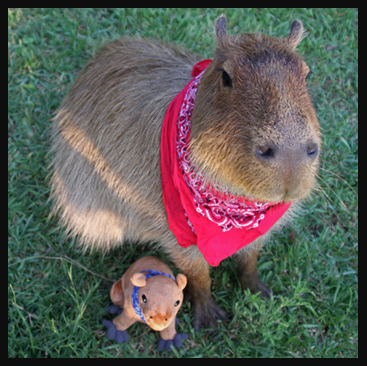
Caplin ROUS and Cappycopy
Melanie explains, “Most veterinarians have no ‘exotic animal’ experience. Since ‘exotic animal’ in vet parlance encompasses anything that is not a dog or a cat, even commonly kept pets such as guinea pigs or hamsters are out of their realm of expertise. Truly exotic animals, like capybaras, fall even farther into the vast expanse of ignorance surrounding their narrow knowledge base. (This is nothing against vets, most of whom are great with their cat/dog patients.) For this reason, it is often difficult to find a vet who will even look at a capybara. Worse, is that the vet’s knowledge may lead them to make incorrect assessments of your animal’s condition.”

Dobby, typical for an adult male at 136 pounds.
Well, okay, how about our recent case? How old is it? What does it weigh? Is this weight typical for the age? How is this capybara doing? We are concerned, how about you?
This is the very basic weight chart that we use. Details to follow.

Use this data to check your capybara’s weight.
Wild capybaras weigh about thirteen pounds at one month. Captive bred capybaras weigh about five pounds at one month. It takes ten months for the captive capybaras to catch up, when they are about the same weight. By a year they are all approaching around seventy pounds. They keep on growing during their second year, but at a slower rate, and 135 pounds is typical for a healthy two-year-old, like my Dobby. (He had pneumonia at five weeks old, but after recovery, his growth rate was phenomenal.)
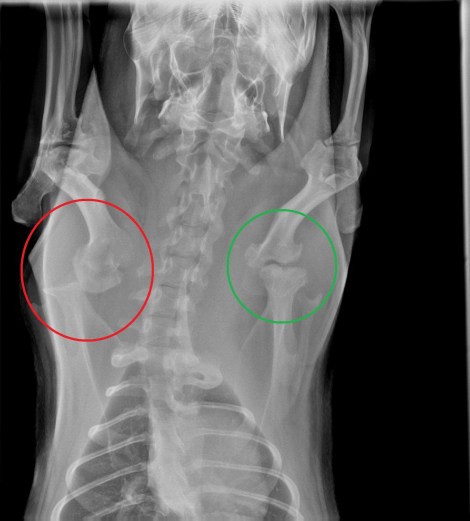
Radiograph of JoeJoe’s shoulders, malformed due to scurvy.
What about smaller capybaras, pets that fall short of typical weights from the start? Little capybaras look healthy, and many well-meaning veterinarians have told owners that low weight is not a problem as long as the capybara has a good appetite and plenty of energy. Like guinea pigs (and chinchillas and humans), capybaras need Vitamin C. This isn’t usually a problem with guinea pigs because their pellets are fortified with Vitamin C. (Rabbits don’t need Vitamin C, so rabbit pellets aren’t supplemented with it).
Wild capybaras are outdoors all the time. They live nearer the equator where the seasons are subtle and daylight hours are consistent, year-round. They graze all night and all day. Okay, sure, they nap, but in urban areas they tend to nap during the heat of the day and graze by moonlight. They wander in large family groups and the little ones graze with their herd. Fresh grass has enough Vitamin C that the wild capybaras don’t need supplements. But they are eating day and night. Pet owners in North America cannot safely provide 24-hour grazing. Our northern states don’t even have grass during the winter- it goes dormant.
Melanie says “Pet capybaras that don’t get enough Vitamin C frequently develop scurvy. We have seen this over and over.” The first symptom we see is low weight gain, and for this reason the ROUS foundation recommends weighing your capybara regularly, as in monthly. Unseen, but more devastating is the structural damage that occurs. Bones do not develop properly, bending and lacking in strength. The skull may not develop the density needed to hold the enormous teeth in place. Scurvy in humans is often accompanied by bleeding gums, but in capybaras the teeth can fall out. The teeth themselves may also not develop proper strength and break easily. A low weight capybara with broken teeth almost surely has scurvy.

Because of early poor nutrition, Garibaldi ROUS’s skull density was not adequate to support his enormous capybara teeth.
Again, from Melanie, veterinarians “will often tell an owner that their capybara’s weight is not a problem as long as it eats well. This may not be the case. Sadly, starving capybaras often appear perfectly healthy to vets. Also, the incredible appetites of healthy, growing capybaras are often underestimated by owners. Healthy capybaras are gluttons. Starving animals need to eat even more. If your capybara has an insatiable appetite, it could be because it is starving The ROUS Foundation has seen this several times, causing the capybara’s death and the owner’s emotional devastation. It is imperative that young capybaras have constant access to high quality food twenty-four hours per day.”
Capybara Cabernet by Will Bullas
How do pet capybara owners avoid scurvy when their pets can’t graze 24 hours a day? Provide foods rich in Vitamin C, all day and all night. Feeding only during the day is not enough. Capybaras are notoriously picky eaters, eating as few as 6 varieties of foliage in the wild. They can usually be convinced to eat melons and sweet potatoes, squash and greens. When grass is available, cut it and bring it in for a bedtime snack. When grass is not available, find a patch of bamboo and bring in fresh foliage. Bamboo, after all, is a type of grass and it’s often available in winter when traditional grass is dormant.

Dobby’s daily bucket of bamboo
In addition to foods rich in Vitamin C, we recommend a supplement. Powdered Vitamin C can be sprinkled over their vegetables. The consensus among veterinarians knowledgeable about capybaras is 250mg for up to 3 months, 500mg for 3 to 6 months, and 1000mg for capybaras older than 6 months. That’s a lot, but it is nearly impossible to get too much Vitamin C. Check out this excellent resource. In fact, if in doubt about feeding your capybara, remember that it is a giant guinea pig, in almost every way.
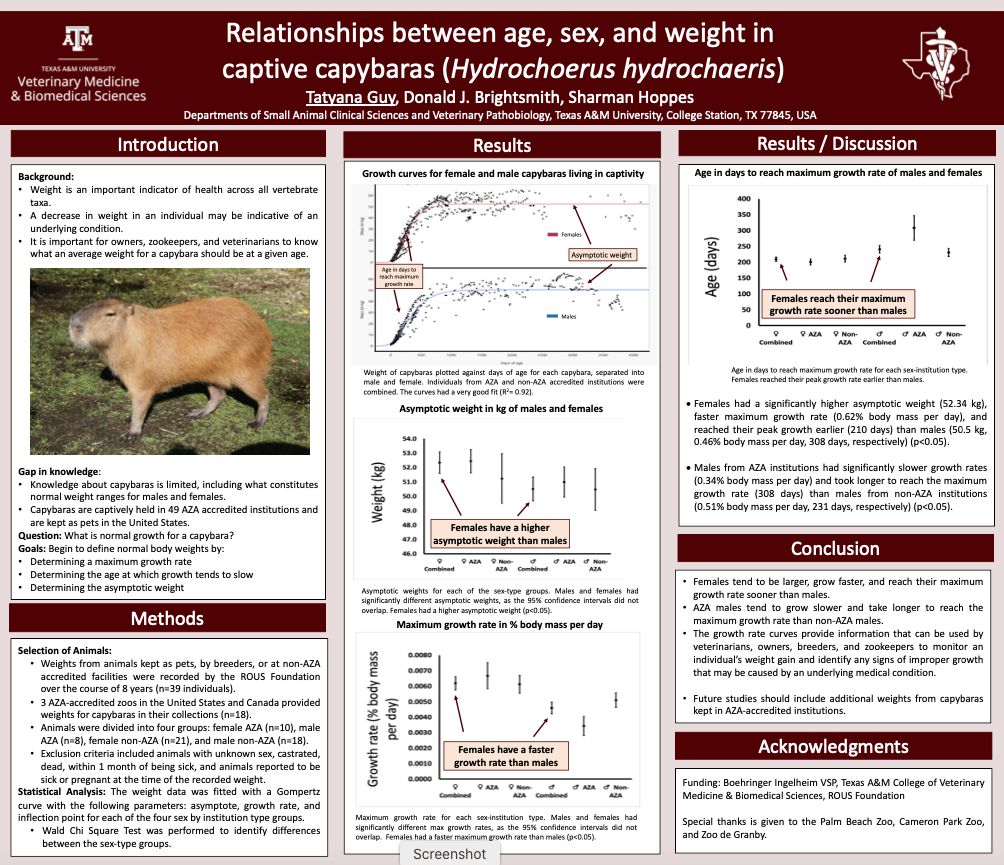
So how is your capybara doing? The ROUS Foundation funded a study that included typical weights of pet capybaras from birth to about a year old. From the abstract:
“Weight is an important indicator of health across all vertebrate taxa . . . Knowledge about capybaras is limited, including what constitutes normal weight ranges for males and females.
The aim of this study was to provide practical information on weights of captive capybaras to begin to define normal body weights. Weights from individuals kept as pets were collected from the ROUS Foundation . . . and individuals kept in 11 AZA-accredited institutions . . . The growth rate curves and estimated weight by sex and age tables provide information that can be used by veterinarians, owners, breeders, and zookeepers to monitor an individual’s weight gain and identify any signs of improper growth that may be caused by an underlying medical condition.”
The following poster will guide you and your veterinarian to determine whether your capybara’s weight is in the normal range. Or you can use the simple chart, above.
ROUS Foundation was a funder and initiator of this research.
I’m going to jump in here and remind you to weigh your capybara monthly. Sometimes, weight loss is the only clue that your capybara’s health is in decline.

Target training your capybara will help him to get on the scale on weighing day.
If in doubt, feed like a guinea pig, but more, and more often. The whole head of romaine lettuce, for instance, every day.
- Supplement with Vitamin C.
- Feed more fruits and vegetables. Refer to the chart of Vitamin C rich foods, above.
- Add fresh greens to the diet- grass or bamboo.
- Make food available night and day.
- Weigh your capybara weekly and make sure the weight is increasing appropriately.
Then, and only then, give us a call! Just kidding, call any time, but please pay attention to time zones!
~~~~~~~~~~
Brought to you by Stacy’s Funny Farm, a small non-profit pet sanctuary. We sincerely hope you will consider making a donation. We especially appreciate monthly giving- the PayPal portal offers that option. If you prefer a no-fee option, our bank uses Zelle. All you need is our email address- stacysfunnyfarm at gmail dot com. If you want to help but are short on cash, head over to Dobby’s YouTube channel. We’re monetized and those ads pay out nicely, so please watch, share, and subscribe.
Stacy’s Funny Farm is a §501(c)(3) non-profit organization.
 Dobby the Capybara