
Let’s look at some capybara news from South America. At any given time, capybaras are co-opting swimming pools, invading posh neighborhoods, causing traffic accidents, and generally being great big silly pests. For some reason only known to the universe, the videos did not embed properly, so when you see a link, go for it. Otherwise, you miss all the fun!
One of the funniest videos I have seen lately is this one. It has been circulated so thoroughly that the original is elusive, but I will gladly post credits when/if I find them. Capybaras are terminally chill, or so they say, but this guy is pushing the limits.
~~~~~~~~~~
This article is about a capybara family living in Rio de Janeiro. A local biologist has been observing capybaras at this site and was saddened when a former family was driven off. He is excited to show photos of the new family, but is understandably reluctant to divulge their location. When I was in Rio, I saw signs of capybara (poop) all along the periphery of the lagoon, but the capybaras were too shy to emerge during the day.
Anticipating World Mangrove Day, celebrated on Friday (26/07), biologist Mario Moscatelli celebrates some new capybaras in Lagoa Rodrigo de Freitas, seen on Monday (22/07). There are those who do not value the least know this, but for him it has great meaning. The exact place where the puppies are don’t say, to protect the animals from humans – in all there are between eight and nine.
“After two years of the massacre of the previous family, we have renewed the expectations of a new family,” says Mario, coordinator of the project “Manguezal da Lagoa”, when recalling the “murder” of the capybaras in 2023, when Margarida would have died at stones, Armando, the male, was also injured, and the six cubs disappeared shortly after the death of the mother. “The family is not asked to be molested in any way. Native species are protected by law,” he says.
The new puppies are probably the sons of Anselm and Victoria, the adults who are left and live there. [translation by google]
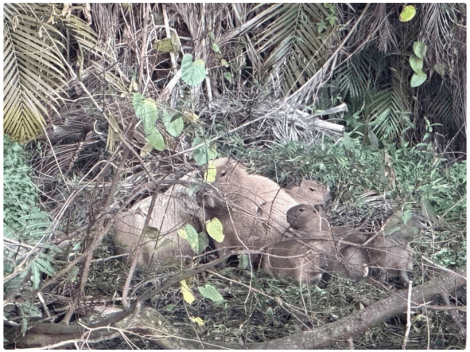
The original article is in Portuguese, but the video is worth a look.
~~~~~~~~~~
Here are your typical capybaras taking advantage of a boat ramp to mosey out of the river into town. A very pregnant female appears to be the ringleader.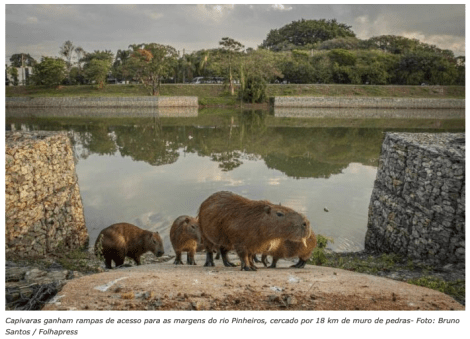
Groups of capybaras that live on the banks of the Pinheiros River, in São Paulo, this month gained access ramps between the watercourse and the grass near the bike path. The novelty, environmentalists say, alleviates the difficulties faced by wild animals in the urban area, but other improvements are necessary.
The stretches of the Pinheiros waterfront that do not have protective structures remain major threats to the animals, warn activists, in addition to the problem of water quality — the target of depollution programs for decades.
Two years ago, the state government began construction work on a gabion wall (structure of stones fixed in metal “cages”) along 18 kilometers, to contain and control erosion in construction sites, during the revitalization work of the cycle path and Bruno Covas park.
The initial project, however, did not include access for animals to exit the river waters within the environmental impact mitigation plan, which was observed by activist Mariana Aidar, president of the NGO Capa (Animal Protection and Support Center). The group works voluntarily at the concessionaire that manages the park and cycle path.
“When I saw the first wall, I scheduled a meeting with the people at Daee [Department of Water and Electricity] and they welcomed me. At that same meeting, they already stopped the works and changed the entire structure of the project to allow the animals to leave,” says the activist.
In July this year, the gabion wall was delivered with 74 access ramps, 250 meters apart, interspersed on each bank, which allow the circulation of local fauna. The work cost R$175.5 million, according to Daee, linked to Semil (Secretariat of Environment, Infrastructure and Logistics).
On Wednesday (17), the reporter traveled along the bike path and saw a group of eight capybaras that used the ramps to get out of the water and access the grass on the banks, which is among the main foods for these large rodents. According to Capa, 120 individuals are monitored in this region. [translation by google]
Of course, allowing access for wildlife means they are causing accidents on the road, and soon they will be begging for lattes at local coffee shops. Feel free to read the remainder of the article in Portuguese, or paste it into google translate, like I did.
~~~~~~~~~~
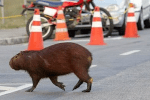
I might add that capybaras are protected animals in Brazil, and even photos of late capybaras are blurred for privacy. Fortunately, most capybaras use crosswalks.


~~~~~~~~~~~
When capybaras go to the beach, they are a bit out of their depth when it comes to swimming. Here is a coastline rescue. It wasn’t easy, but they got him out, cleaned him up, and let him go in a more suitable habitat.

Capivara ferida foi resgatada por agentes da Guarda Ambiental e guarda-vidas da Defesa Civil em Maricá — Foto: Seop
~~~~~~~~~~
Here we have some particularly inept animal control agents. Most agents are well equipped and work well with a team to safely capture stray capybaras. These guys look like they couldn’t capture a dachshund with a hot dog!
This poor capybara had a tire around its neck for a week before they made this hapless attempt to rescue it. To be fair, they can’t dart this capybara because it would dive into the water and drown before they could retrieve it, and these agents are at least aware of that danger. Read more here.
~~~~~~~~~~
Cute family photo, right? It is from an article that also had some great swimming. In a pool.

Capybaras are always swimming around in pools in South America. Animal Control Agents know to wait until they come out for a snack before they try to nab them. Click on the link to see Olympic swimming!
~~~~~~~~~~
Curitiba is the eighth largest city in Brazil, primarily known for its large capybara population. I very recently discovered an Instagram account by Luciano Mochinski, a local there who has posted loads of capybara videos. He’s definitely worth a follow. In fact, if you go to Instagram and search for “Curitiba capivara” a couple dozen accounts pop up. That’s how prevalent capybaras are there.
In fact, there is a pastry shop there that specializes in capybara shaped treats.



~~~~~~~~~~
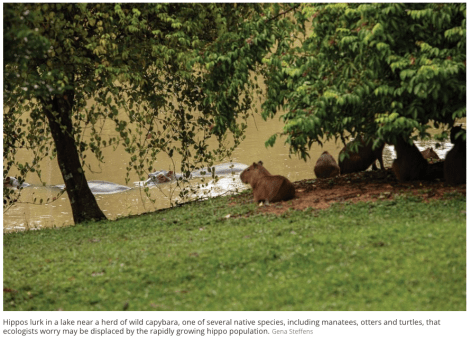
Yes, I know this article is about hippos. The Columbian drug lord, Pablo Escobar, had a large menagerie when he died. They were able to re-locate most of the animals, but hippos are notoriously aggressive. So, there they remain, breeding and pooping all over prime capybara habitat. This is a great Smithsonian article about the problem. There is a second article, that’s how serious the problem is. Required reading, actually.
~~~~~~~~~~
Capybara Marketplace
As always, there are some intriguing capybara products out there. Sorry, most of these are not available in the USA. So frustrating, but a business opportunity for someone. That’s why I didn’t bother to post links, but you can always try to find these items using google image search. Be prepared to be frustrated.
You’ve no doubt seen this lamp. Not available in the USA but if you find one, send one to me, too!










If you have an antique keyboard, why not spiff it up with capybara keycaps?






A dress-up plushie?

How about a burger?

Drinking glasses? I have no idea what is going on here.


~~~~~~~~~~
 Dobby the Capybara