
If you’ve been on the internet, then you know that capybaras are the chilliest animals in the world. Look at that cute little face! So sweet! But are they really as chill as all that? Well, yes and no. Pay careful attention to the “no” part of that statement.

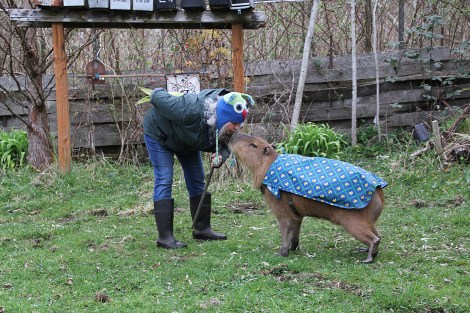
The internet is a fickle thing. It’s hard to predict what will strike a chord with readers of this blog or of my video channel. One thing is sure though, capybaras are not exactly as they are portrayed. Positive, cute videos and stories of capybaras are plentiful, but there is more to them than that.

Wild capybara frequents restaurant in South America.
As wild animals—even tame wild animals—capybaras have most of their evolutionary behaviors intact. This can lead them to be timid or skittish. It can also lead to dominance issues. You often hear about the “fight or flight” behavior of prey animals. This applies to capybaras who have a horrible array of predators in the wild. They have a lot of reasons to flee any suspected danger. The fight response does not work well against jaguars or caiman, or anacondas, but sometimes it’s the only thing a capybara can do. If cornered, a capy will stand its ground. In captivity, a capybara may misinterpret its situation and react inappropriately.
-

- Dobby
-
- Caplin
-

- JoeJoe
-

- Gari
As pets, capybaras span a wide range of personalities. Because they are social animals, a capybara will typically bond closely to at least one human. But not all humans may be treated equally. A capybara may be extremely affectionate with one person, but intolerant or even aggressive toward another. A capybara may be playful and loving with well-known humans but cower in fear over strangers. In this way, they are like people; you get along with some and not with others.

Melanie, Stacy, and Gari
The reputation for getting-along-with-everyone is pretty true. Even in the wild, capybaras can be seen hanging out with some pleasant, or sometimes unsavory, characters. Birds of all kinds like to sit on capybaras. Various videos show captive capybaras interacting—or stoically tolerating—animals of various species: cats, dogs, rats, guinea pigs, chickens, mini-pigs, rabbits, squirrels. Capybaras are in seventh-heaven when another animal is touching them. They often flop themselves on the ground and roll belly-up for a scratch. A truly happy capybara looks like a porcupine with all of its spines sticking straight out. You can see through the forest of straw-like hairs all the way down to their pink skin. They can be a bit demanding about this at times. Those big, dank eyes have a way of making you feel guilty if you don’t give them a good scratch.

Capybaras do love their hens. Also cats, puppies, guinea pigs, and just about everything else.
Another variable in capybara personalities is their interest in learning new behaviors or tricks. Capybaras are smart. Really smart. They can learn new behaviors faster than most dogs, although they have no interest in chasing after things. Chasing is a predatory behavior and capybaras are not predators. There are a lot of videos on YouTube showing capybaras performing tricks like sit, shake, lie down, typical dog stuff. More unusual skills are standing on the hind legs—some even walking like this—turning a circle, going down a side, flying over a jump, kissing. It should be noted that although they can learn a huge variety of things, they can’t learn to do any of them fast. If a capybara replaced the tortoise in the tortoise and the hare fable, the capybara would still probably lose even if the hare took a very long nap.
Except in the water.
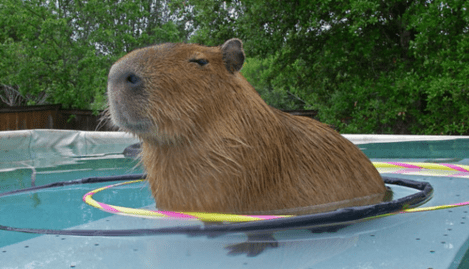
Capybaras are mere shadows of their true selves on dry land; in the water they are completely different animals. Even the most aquatic of dogs is put to shame by a capybara. Although there is a capy equivalent to “dog-paddle,” the closest animal to resemble a capybara in the water is a seal. Capys are fast, agile, playful swimmers. They often bounce off the walls of a pool. Their dives rival those of Olympic swimmers. They are as comfortable swimming upside-down as right-side-up. If you visit capybaras in a zoo, ask first if there is a time when they typically swim so you cab be sure to see it.


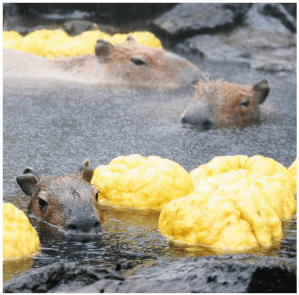
The truth is, you should not be fooled by the internet. A lot of what is out there about capybaras is adorable and cute. But not everything is out there. As with nearly everything, telling only some of the truth can be much the same as telling none of the truth.
~~~~~~~~~~
Capybaras for Home and Garden is an in-progress capybara owner’s manual brought to you by the ROUS Foundation. Melanie Typaldos and I will post sample sections as they become available, in no particular order. (This chapter was written by Melanie.) Eventually, they will become a book, but for now, we welcome requests for topics you would like us to cover. Online capybara information is hit-and-miss, so our challenge is to compile all these bits into one comprehensive volume. We don’t claim to know everything, but we hope you won’t repeat our mistakes!
~~~~~~~~~~
Dobby the Capybara blog posts are brought to you by Stacy’s Funny Farm, a non-profit pet sanctuary in the Pacific Northwest. We sincerely hope you will consider making a donation. We especially appreciate monthly giving- the PayPal portal offers that option. If you prefer a no-fee option, our bank uses Zelle. All you need is our email address- stacysfunnyfarm at gmail dot com. If you want to help but are short on cash, head over to Dobby’s YouTube channel. We’re monetized and those ads pay out nicely, so please watch, share, and subscribe.
~~~~~~~~~~


 Dobby the Capybara